

Table of Contents:
1. Introduction: D-Limonene vs Limonene
2. Understanding Limonene Isomers and Terminology
3. Purity Levels and Quality Standards
4. Key Differences in Performance and Properties
5. Application-Specific Selection Criteria
6. Regulatory and Industry Requirements
7. Choosing the Right Grade for Your Business
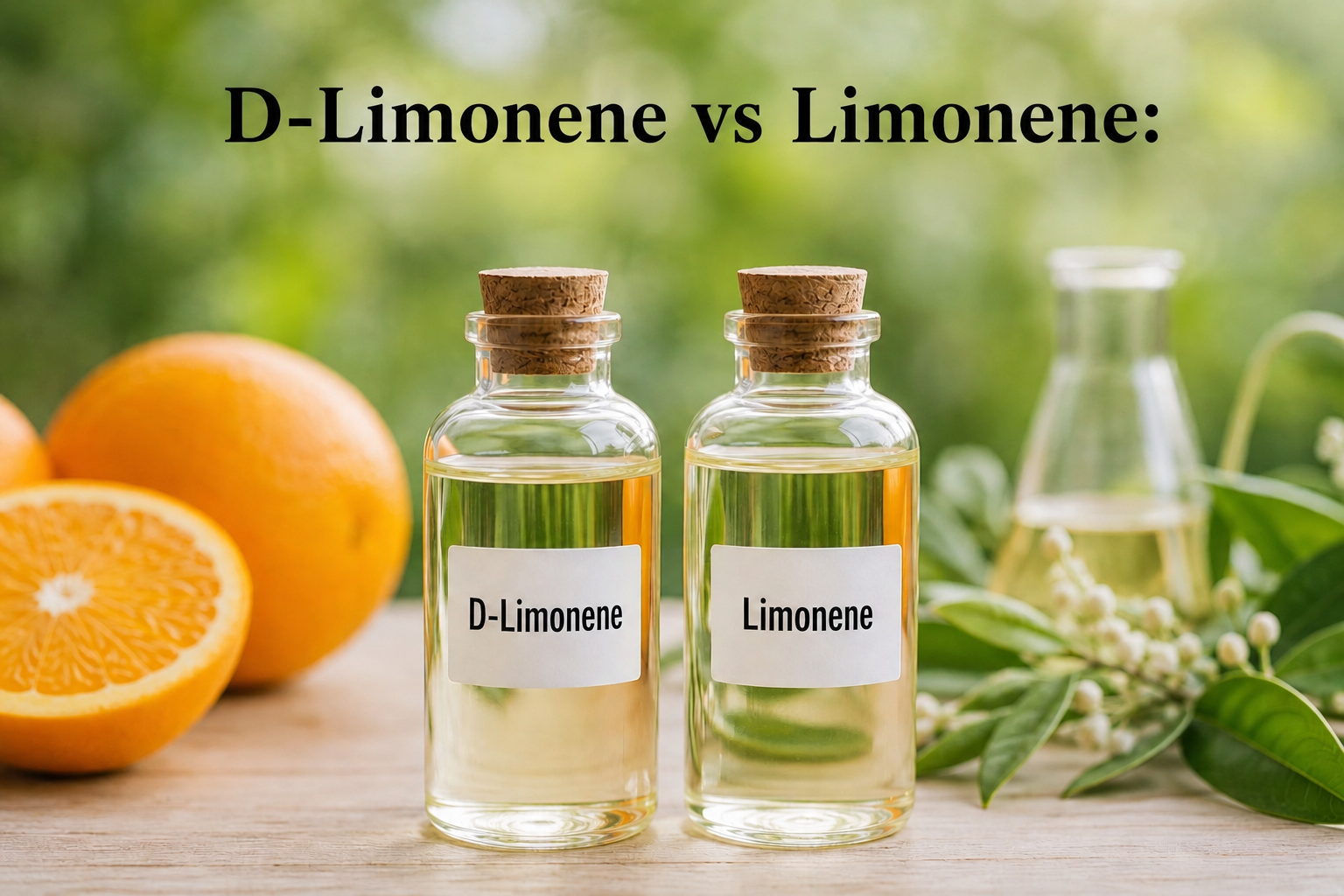
The terms D-Limonene and Limonene are often used interchangeably in industries ranging from food and beverages to cosmetics, pharmaceuticals, and cleaning products. However, while they are closely related, there are important distinctions between these compounds that consumers, manufacturers, and researchers should understand.
Limonene is a naturally occurring terpene found in the peels of citrus fruits such as oranges, lemons, limes, and grapefruits. It is responsible for the fresh citrus aroma that many people associate with these fruits. D-Limonene, on the other hand, is a specific optical isomer of limonene and is the most common form found in nature.
As demand for natural ingredients, eco-friendly solvents, and plant-based chemicals continues to grow, understanding the differences between D-Limonene vs Limonene becomes increasingly important.
1) Introduction: D-Limonene vs Limonene

What is Limonene?
Limonene is a cyclic monoterpene hydrocarbon with the molecular formula C10H16. It belongs to a class of compounds known as terpenes, which are naturally produced by many plants.
Limonene exists in two primary isomeric forms:
- D-Limonene (dextro-limonene)
- L-Limonene (levo-limonene)
The two forms have identical chemical compositions but differ in how they interact with polarized light.
Key Characteristics of Limonene
- Naturally found in citrus fruit peels
- Colorless liquid at room temperature
- Strong citrus aroma
- Biodegradable and environmentally friendly
- Widely used in fragrances and flavorings
Because of its versatility, limonene is one of the most commercially important terpenes worldwide.
What is D-Limonene?
D-Limonene is the naturally occurring form of limonene found predominantly in orange peels. The "D" designation refers to the molecule's optical rotation, meaning it rotates polarized light in a clockwise direction.
This isomer is extracted primarily through:
- Cold pressing citrus peels
- Steam distillation
- Citrus processing byproducts
Characteristics of D-Limonene
- Sweet orange-like fragrance
- Naturally derived from citrus fruits
- Excellent solvent properties
- Renewable and sustainable source
- Commonly recognized as safe (GRAS)
Due to its pleasant scent and effectiveness as a solvent, D-Limonene has become a preferred alternative to petroleum-based chemicals.
D-Limonene vs Limonene: Key Differences
Although people often use the terms interchangeably, there are subtle but important differences.
|
Feature |
D-Limonene |
Limonene |
|
Definition |
Specific isomer of limonene |
General term covering all limonene isomers |
|
Natural Source |
Primarily citrus peels |
Various plants and citrus fruits |
|
Aroma |
Sweet orange scent |
Depends on isomer type |
|
Industrial Use |
Most widely used form |
Includes all forms |
|
Commercial Availability |
Highly available |
General category |
In simple terms, all D-Limonene is limonene, but not all limonene is D-Limonene.
Chemical Structure of D-Limonene
The molecular structure of D-Limonene contributes to its unique characteristics.
Chemical Information
- Molecular Formula: C10H16
- Molecular Weight: 136.24 g/mol
- Boiling Point: 176°C
- Density: 0.841 g/cm³
- Appearance: Clear liquid
Its structure allows it to dissolve oils, greases, waxes, and many organic substances efficiently.
Natural Sources of D-Limonene
D-Limonene is naturally abundant in citrus fruits.
Major Sources
- Orange peels
- Lemon peels
- Lime peels
- Grapefruit peels
- Mandarin peels
Orange peels contain the highest concentration, often exceeding 90% of the essential oil composition.
This makes citrus processing waste a valuable source for commercial D-Limonene extraction.
Benefits of D-Limonene
1. Natural Cleaning Power
One of the most significant advantages of D-Limonene is its exceptional cleaning capability.
It effectively removes:
- Grease
- Oil
- Adhesives
- Tar
- Wax residues
As a result, it is widely used in industrial cleaners, degreasers, and household cleaning products.
2. Eco-Friendly Solvent
Traditional solvents often contain harsh chemicals that can harm the environment.
D-Limonene offers a sustainable alternative because it is:
- Biodegradable
- Renewable
- Low toxicity
- Derived from natural sources
Many companies are switching to green solvents containing D-Limonene to support sustainability goals.
3. Pleasant Citrus Fragrance
Unlike many industrial solvents with strong chemical odors, D-Limonene provides a fresh citrus scent.
This makes it ideal for:
- Air fresheners
- Cleaning products
- Personal care formulations
- Aromatherapy products
4. Potential Health Benefits
Research suggests that D-Limonene may offer several biological benefits.
Studies have explored its potential role in:
- Supporting digestive health
- Reducing occasional heartburn
- Providing antioxidant activity
- Promoting cellular health
While ongoing research continues, D-Limonene remains a popular ingredient in dietary supplements.
2) Understanding Limonene Isomers and Terminology

When discussing limonene, many people encounter terms such as D-Limonene, L-Limonene, DL-Limonene, limonene isomers, and citrus terpenes. While these terms may appear confusing at first, understanding the terminology behind limonene is essential for professionals working in the chemical industry, flavor and fragrance manufacturing, cleaning products, food processing, and cosmetic formulations.
As one of the most abundant and commercially valuable natural terpenes, limonene plays a significant role in numerous industrial applications. However, not all limonene molecules are identical. Different limonene isomers exhibit distinct characteristics, aromas, and commercial uses.
What Are Isomers?
Before understanding limonene isomers, it is important to understand the concept of isomerism.
Isomers are compounds that share the same molecular formula but differ in the arrangement of their atoms or spatial orientation.
In the case of limonene, the molecular formula remains:
C10H16
However, different spatial arrangements create different optical forms known as enantiomers.
These enantiomers have identical chemical compositions but interact differently with polarized light and often produce different aromas.
The Main Limonene Isomers
There are three primary forms commonly discussed in industry:
D-Limonene
L-Limonene
DL-Limonene (Racemic Limonene)
Each form possesses unique properties despite sharing the same molecular structure.
Understanding D-Limonene
D-Limonene is the most common naturally occurring limonene isomer.
It is predominantly found in:
- Orange peel oil
- Lemon peel oil
- Citrus essential oils
Characteristics of D-Limonene
- Sweet citrus aroma
- Orange-like fragrance
- Renewable natural source
- Excellent solvent properties
- Commercially dominant isomer
Because of its pleasant scent and effectiveness, D-Limonene is widely used in:
- Industrial cleaners
- Degreasers
- Personal care products
- Food flavorings
- Eco-friendly solvents
In fact, when manufacturers simply refer to "limonene" in commercial products, they are often referring to D-Limonene.
Understanding L-Limonene
L-Limonene is the mirror image of D-Limonene.
Although chemically identical, it exhibits different sensory characteristics.
Characteristics of L-Limonene
- Pine-like aroma
- Turpentine-like scent
- Less common in nature
- Different fragrance applications
Because its fragrance profile differs significantly, L-Limonene finds specialized use in certain fragrance and chemical formulations.
Understanding DL-Limonene
DL-Limonene is a racemic mixture containing equal amounts of:
- D-Limonene
- L-Limonene
This mixture exhibits properties that differ slightly from either pure isomer.
Features of DL-Limonene
- Mixed aroma profile
- Synthetic production common
- Industrial applications
- Specialty chemical formulations
The presence of both optical forms results in a less distinctive citrus scent compared to pure D-Limonene.
Optical Isomerism in Limonene
One of the most important concepts in understanding limonene terminology is optical isomerism.
Optical isomers are molecules that are mirror images of each other but cannot be superimposed.
This phenomenon is similar to how your left and right hands appear identical yet cannot perfectly overlap.
Why It Matters
Although D-Limonene and L-Limonene share:
- Molecular formula
- Molecular weight
- Chemical composition
They differ in:
- Odor characteristics
- Biological interactions
- Commercial applications
These differences make isomer identification critical in many industries.
Common Limonene Terminology Explained
Citrus Terpene
A broad term referring to terpene compounds obtained from citrus fruits.
D-Limonene is the primary citrus terpene.
Orange Terpene
Commercial term often used interchangeably with D-Limonene because orange oil contains extremely high concentrations of this compound.
Terpene Solvent
Refers to solvents derived from natural terpenes such as D-Limonene.
Widely used in:
- Industrial cleaning
- Adhesive removal
- Surface preparation
Food Grade Limonene
Highly purified limonene approved for use in food and beverage applications.
Technical Grade Limonene
Industrial-grade limonene used for cleaning, degreasing, and chemical manufacturing.
3) Purity Levels and Quality Standards

The demand for high-purity D-Limonene, food-grade limonene, industrial-grade limonene, and natural citrus solvents continues to grow across multiple industries. From cleaning products and food manufacturing to cosmetics, pharmaceuticals, and green chemistry applications, the quality and purity of D-Limonene directly impact product performance, safety, compliance, and consumer satisfaction.
Understanding D-Limonene purity levels, quality standards, and industry specifications is essential for manufacturers, distributors, formulators, and procurement professionals. Different applications require different grades of limonene, and selecting the appropriate purity level ensures optimal results while meeting regulatory requirements.
Common D-Limonene Purity Levels
90% D-Limonene
90% D-Limonene is commonly used in general industrial applications.
Typical Uses
- Industrial degreasers
- Surface cleaners
- Adhesive removers
- Manufacturing processes
Benefits include cost-effectiveness and adequate cleaning performance.
95% D-Limonene
95% D-Limonene provides improved consistency and purity.
Applications
- Commercial cleaning products
- Fragrance formulations
- Industrial solvents
- Specialty chemical blends
This grade balances performance and affordability.
97% D-Limonene
97% D-Limonene is widely used in premium industrial and commercial products.
Common Industries
- Cosmetics
- Personal care
- Household cleaners
- Industrial maintenance products
Higher purity helps improve fragrance quality and formulation stability.
98% D-Limonene
98% D-Limonene is often considered a premium commercial grade.
Typical Uses
- Food flavoring applications
- Personal care products
- Pharmaceutical ingredients
- High-performance solvents
Many manufacturers prefer this grade for products requiring enhanced consistency.
99% D-Limonene
99% D-Limonene represents one of the highest commercially available purity levels.
Applications
- Pharmaceutical formulations
- Food-grade products
- Research laboratories
- Specialty chemical manufacturing
This grade offers exceptional quality and minimal impurities.
Key Quality Standards for D-Limonene
ISO Standards
Many manufacturers follow internationally recognized ISO quality management standards.
Benefits include:
- Consistent production
- Quality control
- Traceability
- Process standardization
GMP Compliance
Good Manufacturing Practices (GMP) are critical for:
- Food ingredients
- Pharmaceutical ingredients
- Nutraceutical products
GMP compliance helps ensure product safety and consistency.
FDA Considerations
In many regions, D-Limonene used in food applications must comply with relevant food safety regulations.
Manufacturers often provide supporting documentation to verify compliance.
REACH Compliance
For global trade, especially in Europe, REACH compliance is often required.
This regulation helps ensure chemical safety and environmental responsibility.
Quality Testing Methods for D-Limonene
Reliable suppliers perform extensive testing to verify purity and quality.
Gas Chromatography (GC)
One of the most common analytical techniques.
Measures:
- D-Limonene concentration
- Impurity levels
- Isomer distribution
Gas Chromatography-Mass Spectrometry (GC-MS)
Provides detailed chemical analysis.
Used to identify:
- Trace contaminants
- Oxidation products
- Residual compounds
Specific Gravity Testing
Determines product consistency and verifies conformity to specifications.
Refractive Index Testing
Used to assess:
- Purity
- Identity
- Batch consistency
Optical Rotation Analysis
Particularly important for confirming the presence of D-Limonene rather than other limonene isomers.
Factors Affecting D-Limonene Quality
Several factors influence the quality of natural D-Limonene.
Raw Material Source
The quality of citrus fruit peels directly affects final product quality.
Premium sources include:
- Sweet oranges
- Lemons
- Grapefruits
- Mandarins
Extraction Method
Common extraction methods include:
Cold Pressing
Preserves natural characteristics.
Steam Distillation
Provides high-quality essential oil recovery.
Advanced Purification
Improves purity and removes unwanted compounds.
Storage Conditions
Improper storage may lead to:
- Oxidation
- Reduced purity
- Color changes
- Odor degradation
Proper storage extends shelf life and maintains product quality.
4) Key Differences in Performance and Properties

When comparing D-Limonene vs Limonene, many buyers, formulators, and manufacturers focus on price or availability. However, the most important differences are found in their performance, chemical properties, purity levels, aroma profile, solvent strength, and industrial applications.
Although limonene is the general name for a group of terpene compounds, D-Limonene is the most commercially important and naturally abundant form. It is widely used in cleaning products, industrial degreasers, fragrance formulations, food flavoring, cosmetics, and green solvent applications.
What Is the Main Difference Between D-Limonene and Limonene?
The main difference is that limonene is a broad chemical term, while D-Limonene refers to a specific natural isomer of limonene.
In simple terms:
All D-Limonene is limonene, but not all limonene is D-Limonene.
This distinction is important because different limonene isomers may vary in:
- Odor profile
- Optical rotation
- Solvent performance
- Purity
- Natural origin
- Commercial applications
For most industrial and commercial uses, D-Limonene is preferred because it offers strong cleaning power, a fresh citrus aroma, and excellent compatibility with many formulations.
Chemical Properties of D-Limonene
D-Limonene is a monoterpene hydrocarbon commonly extracted from citrus peel oils, especially orange-peel oil.
Key chemical properties include:
- Molecular formula: C10H16
- Appearance: Clear, colorless to pale yellow liquid
- Odor: Fresh, sweet citrus aroma
- Solubility: Insoluble in water but soluble in oils and organic solvents
- Boiling point: Around 176°C
- Function: Natural solvent, fragrance ingredient, flavoring agent
These properties make D-Limonene highly valuable in both consumer products and industrial chemical formulations.
Performance Difference in Cleaning Applications
One of the most important performance advantages of D-Limonene is its strong cleaning and degreasing ability.
D-Limonene Cleaning Performance
D-Limonene performs well in removing:
- Grease
- Oil
- Adhesives
- Tar
- Wax
- Resin
- Ink residues
- Sticky labels
Because of this, D-Limonene solvent is commonly used in:
- Industrial degreasers
- Citrus cleaners
- Adhesive removers
- Automotive cleaners
- Heavy-duty surface cleaners
- Eco-friendly cleaning products
Compared with general limonene blends, high-quality D-Limonene usually provides more consistent cleaning performance because of its higher purity and stronger citrus terpene concentration.
Solvent Strength and Dissolving Power
Another major difference between D-Limonene and limonene is solvent efficiency.
D-Limonene has excellent dissolving power for non-polar substances. This makes it especially useful for cleaning oil-based contaminants.
Substances D-Limonene Can Dissolve
D-Limonene is effective against:
- Oils
- Greases
- Waxes
- Rubber residues
- Asphalt stains
- Pressure-sensitive adhesives
- Certain resins
This strong solvent performance makes D-Limonene a preferred alternative to many petroleum-based solvents.
For manufacturers looking for a natural solvent, bio-based solvent, or green chemistry ingredient, D-Limonene offers a strong balance between performance and sustainability.
Aroma and Fragrance Differences
Aroma is one of the clearest differences among limonene isomers.
D-Limonene Aroma
D-Limonene has a bright, sweet, orange-like citrus smell. This makes it ideal for:
- Air fresheners
- Perfumes
- Cleaning products
- Personal care products
- Cosmetics
- Soaps and detergents
L-Limonene Aroma
L-Limonene has a more pine-like or turpentine-like odor. It is less commonly used in mainstream citrus fragrance products.
Because of its pleasant scent, D-Limonene is usually preferred in applications where fragrance quality matters.
Purity and Quality Performance
The performance of D-Limonene depends heavily on purity.
Common purity levels include:
- 90% D-Limonene
- 95% D-Limonene
- 97% D-Limonene
- 98% D-Limonene
- 99% D-Limonene
Higher purity generally means:
- Better odor consistency
- Stronger solvent performance
- Lower impurity content
- Better formulation stability
- Improved product quality
For example, industrial-grade D-Limonene may be suitable for cleaners and degreasers, while food-grade D-Limonene or pharmaceutical-grade D-Limonene requires stricter purity standards and quality testing.
Performance in Industrial Applications
D-Limonene is widely used in industrial sectors because it combines high performance with natural sourcing.
Common Industrial Uses
- Metal degreasing
- Parts cleaning
- Adhesive removal
- Paint cleanup
- Resin removal
- Printing ink cleaning
- Automotive maintenance
- Surface preparation
In many applications, D-Limonene solvent provides effective cleaning without the harsh odor often associated with synthetic solvents.
This makes it attractive for companies seeking eco-friendly industrial cleaners and sustainable chemical solutions.
Performance in Food and Beverage Applications
In the food and beverage industry, food-grade D-Limonene is valued for its natural citrus flavor and aroma.
It may be used in:
- Beverages
- Candies
- Baked goods
- Chewing gum
- Flavor concentrates
- Nutritional products
For food applications, purity and compliance are extremely important. Manufacturers must use food-grade limonene that meets strict quality and safety requirements.
Industrial-grade material should never be used for food products.
Performance in Cosmetics and Personal Care
In cosmetic formulations, D-Limonene is mainly used as a fragrance ingredient and solvent.
It appears in:
- Perfumes
- Lotions
- Shampoos
- Body washes
- Facial cleansers
- Natural skincare products
- Essential oil blends
The fresh citrus scent of D-Limonene helps improve the sensory appeal of personal care products. However, formulators must control dosage levels and oxidation because oxidized limonene may cause skin sensitivity in some users.
Comparison Table: D-Limonene vs Limonene Performance
|
Feature |
D-Limonene |
General Limonene |
|
Definition |
Specific natural isomer |
Broad term for limonene isomers |
|
Aroma |
Sweet orange citrus |
Depends on isomer composition |
|
Solvent strength |
Strong and consistent |
May vary |
|
Natural availability |
Highly abundant in citrus peel |
Can include different forms |
|
Main use |
Cleaning, fragrance, food, cosmetics |
General chemical category |
|
Market demand |
Very high |
Depends on grade and type |
|
Sustainability |
Strong bio-based profile |
Depends on source |
|
Quality consistency |
High when purified |
Varies by supplier |
Which One Performs Better?
For most commercial purposes, D-Limonene performs better because it is widely available, naturally sourced, pleasant-smelling, and highly effective as a solvent.
D-Limonene is usually the better choice for:
- Citrus-based cleaners
- Industrial degreasers
- Natural fragrance products
- Food flavoring
- Cosmetic formulations
- Eco-friendly solvents
- Green cleaning products
General limonene may be acceptable when the exact isomer is not critical, but for high-performance applications, buyers should confirm whether the product is specifically D-Limonene.
5) Application-Specific Selection Criteria

As demand for D-Limonene, natural citrus solvents, green cleaning ingredients, and bio-based chemicals continues to grow, selecting the right type of limonene for a specific application has become increasingly important. While D-Limonene is widely recognized for its excellent solvent power, pleasant citrus aroma, and renewable origin, not every grade or purity level is suitable for every use.
Different industries including industrial cleaning, food and beverage manufacturing, cosmetics, pharmaceuticals, fragrances, and chemical processing have unique requirements regarding purity, performance, regulatory compliance, safety, and cost. Choosing the wrong grade of D-Limonene can affect product quality, operational efficiency, and compliance with industry standards.
Key Factors to Consider When Selecting D-Limonene
Before choosing a D-Limonene grade, businesses should evaluate several critical criteria.
Purity Level
One of the most important considerations is D-Limonene purity.
Common purity grades include:
- 90% D-Limonene
- 95% D-Limonene
- 97% D-Limonene
- 98% D-Limonene
- 99% D-Limonene
Higher purity levels typically provide:
- Better consistency
- Improved solvent performance
- Lower impurity content
- Enhanced fragrance quality
- Greater formulation stability
Industries such as pharmaceuticals and food manufacturing generally require higher purity standards than industrial cleaning applications.
Regulatory Compliance
Regulatory requirements vary significantly by industry.
Important certifications and compliance standards may include:
- FDA compliance
- REACH compliance
- GMP certification
- Food-grade certification
- ISO quality standards
- Safety Data Sheets (SDS)
- Certificate of Analysis (COA)
Selecting compliant D-Limonene suppliers helps ensure legal and operational requirements are met.
Performance Requirements
Different applications require different performance characteristics.
Key considerations include:
- Solvent strength
- Cleaning efficiency
- Fragrance quality
- Stability
- Compatibility with formulations
- Evaporation rate
Understanding application needs allows businesses to select the most suitable grade.
D-Limonene Selection for Industrial Cleaning Applications
The industrial cleaning industry is one of the largest consumers of D-Limonene.
Selection Criteria for Industrial Cleaners
Important factors include:
Solvent Power
Industrial cleaners require strong dissolving capabilities for:
- Grease
- Oil
- Wax
- Adhesives
- Resins
- Tar
Cost Efficiency
Many industrial applications prioritize performance-to-cost ratio rather than ultra-high purity.
Compatibility
The selected D-Limonene solvent should be compatible with:
- Metals
- Plastics
- Equipment surfaces
- Existing formulations
Recommended Grade
For most industrial cleaning applications:
- 90–97% D-Limonene
- Industrial-grade D-Limonene
These grades offer effective performance while maintaining cost efficiency.
Selecting D-Limonene for Food and Beverage Applications
The food industry has some of the strictest quality requirements.
Important Selection Factors
Food-Grade Certification
Only food-grade D-Limonene should be used in edible products.
Purity Standards
Higher purity levels help minimize contaminants and ensure flavor consistency.
Flavor Profile
The citrus flavor must remain stable and consistent across production batches.
Regulatory Compliance
Compliance with relevant food regulations is essential.
Recommended Grade
For food and beverage formulations:
- 98% D-Limonene
- 99% D-Limonene
- Certified food-grade material
Selecting D-Limonene for Cosmetic Applications
The cosmetics and personal care industry uses D-Limonene primarily for fragrance and formulation purposes.
Selection Criteria
Fragrance Quality
A clean, fresh citrus aroma is essential.
Purity
Higher purity often results in better fragrance consistency.
Oxidation Stability
Oxidized limonene may affect product quality and skin compatibility.
Formulation Compatibility
The ingredient should blend well with:
- Essential oils
- Emollients
- Surfactants
- Active ingredients
Recommended Grade
Most cosmetic manufacturers prefer:
- 97–99% D-Limonene
- Cosmetic-grade D-Limonene
D-Limonene Selection for Pharmaceutical Applications
Pharmaceutical applications demand exceptionally high-quality standards.
Critical Requirements
Maximum Purity
Pharmaceutical formulations require minimal impurities.
GMP Manufacturing
Products should be produced under Good Manufacturing Practices (GMP).
Quality Documentation
Essential documents include:
- COA
- SDS
- Batch records
- Traceability reports
Consistency
Batch-to-batch consistency is vital for pharmaceutical manufacturing.
Recommended Grade
For pharmaceutical use:
- 99% D-Limonene
- Pharmaceutical-grade D-Limonene
Selecting D-Limonene for Fragrance and Perfume Manufacturing
The fragrance industry places significant emphasis on aroma characteristics.
Important Selection Factors
Citrus Aroma Quality
The fragrance should be:
- Fresh
- Bright
- Natural
- Consistent
Purity
Impurities can alter fragrance profiles.
Stability
Long-term aroma stability is critical.
Supplier Consistency
Reliable sourcing ensures fragrance consistency across product lines.
Recommended Grade
Most fragrance manufacturers select:
- 98–99% D-Limonene
- High-aroma specialty grades
Selection Criteria for Adhesive Removal Applications
D-Limonene adhesive removers are widely used in industrial and commercial settings.
Key Requirements
Solvent Strength
The product should effectively dissolve:
- Pressure-sensitive adhesives
- Labels
- Stickers
- Tape residues
Evaporation Characteristics
Controlled evaporation improves cleaning efficiency.
Surface Safety
Compatibility with sensitive materials is essential.
Recommended Grade
For adhesive removal:
- 95–98% D-Limonene
- Industrial-grade formulations
D-Limonene Selection for Green Chemistry Applications
Sustainability is becoming a major purchasing factor.
Important Sustainability Criteria
Renewable Source
Products derived from citrus byproducts support sustainable manufacturing.
Biodegradability
Environmentally friendly degradation characteristics are desirable.
Reduced Environmental Impact
Many organizations seek alternatives to petroleum-based solvents.
Carbon Footprint Considerations
Natural citrus-derived solvents support sustainability initiatives.
Recommended Grade
For green chemistry applications:
- High-purity natural D-Limonene
- Certified renewable-source material
6) Regulatory and Industry Requirements

Manufacturers, distributors, importers, and formulators must understand the complex landscape of D-Limonene regulations to ensure product safety, legal compliance, environmental responsibility, and consumer confidence. Failure to comply with applicable regulations can result in product recalls, import restrictions, financial penalties, and reputational damage.
FDA Requirements for D-Limonene
In the United States, products containing D-Limonene may fall under regulations administered by the U.S. Food and Drug Administration (FDA).
Food and Beverage Applications
When used as a flavoring substance, food-grade D-Limonene must comply with applicable food safety requirements.
Important considerations include:
- Ingredient purity
- Manufacturing controls
- Food-contact suitability
- Labeling compliance
- Quality documentation
Manufacturers should verify that suppliers provide proper documentation supporting regulatory compliance.
Dietary Supplements
When used in supplements, manufacturers must ensure compliance with:
- Good Manufacturing Practices (GMP)
- Ingredient quality standards
- Product safety requirements
- Proper labeling regulations
Good Manufacturing Practices (GMP)
One of the most important industry standards for high-purity D-Limonene is GMP compliance.
What Is GMP?
Good Manufacturing Practices (GMP) are quality management systems designed to ensure consistent production and control.
GMP requirements typically include:
- Controlled manufacturing processes
- Employee training
- Equipment validation
- Quality testing
- Documentation management
- Traceability systems
Industries such as pharmaceuticals, food, and nutraceuticals often require GMP-compliant ingredients.
REACH Compliance for D-Limonene
For companies operating in Europe, REACH compliance is one of the most important regulatory requirements.
What Is REACH?
REACH (Registration, Evaluation, Authorization and Restriction of Chemicals) is a European Union regulation governing chemical substances.
REACH aims to:
- Protect human health
- Protect the environment
- Improve chemical safety
- Increase transparency
Manufacturers and importers of D-Limonene in Europe must ensure compliance with relevant REACH obligations.
CLP Regulation Requirements
Another important European regulation is the CLP Regulation.
What Is CLP?
CLP stands for:
Classification, Labelling and Packaging Regulation
It requires businesses to properly:
- Classify hazards
- Label products
- Package chemicals safely
- Communicate risks effectively
Companies supplying D-Limonene-based products within Europe must ensure proper CLP compliance.
ISO Standards and Quality Management
Many manufacturers adopt internationally recognized ISO standards to support product quality and regulatory compliance.
ISO 9001
ISO 9001 focuses on quality management systems.
Benefits include:
- Consistent product quality
- Process improvement
- Customer satisfaction
- Risk management
ISO 14001
ISO 14001 addresses environmental management.
These standard supports:
- Sustainable manufacturing
- Environmental responsibility
- Waste reduction
- Resource efficiency
For producers of natural D-Limonene, ISO certifications demonstrate commitment to quality and sustainability.
Safety Data Sheet (SDS) Requirements
Every supplier of industrial-grade D-Limonene should provide a current Safety Data Sheet (SDS).
Purpose of an SDS
An SDS provides information regarding:
- Product identification
- Hazard classifications
- Safe handling procedures
- Storage recommendations
- Emergency measures
- First-aid information
- Environmental precautions
SDS documentation is often required by workplace safety regulations worldwide.
Certificate of Analysis (COA)
The Certificate of Analysis (COA) is one of the most important quality assurance documents.
Information Included in a COA
A typical COA contains:
- Purity percentage
- Batch number
- Manufacturing date
- Test results
- Quality specifications
- Analytical data
Purchasing high-purity D-Limonene without a COA may create compliance and quality risks.
Food Safety Requirements
When D-Limonene is used in food applications, manufacturers must meet stringent safety standards.
Key Food Industry Requirements
Ingredient Traceability
Companies must be able to track ingredients throughout the supply chain.
Contaminant Control
Testing should verify acceptable levels of:
- Residual solvents
- Heavy metals
- Pesticides
- Impurities
Supplier Qualification
Approved suppliers should maintain documented quality systems.
Recommended Documentation
- COA
- Technical Data Sheet
- Food-grade certification
- Supplier audit records
7) Choosing the Right Grade for Your Business
Choosing the right D-Limonene grade is one of the most important decisions for businesses using natural solvents, bio-based chemicals, citrus terpenes, and eco-friendly ingredients. Whether your company manufactures industrial cleaners, food flavorings, cosmetics, pharmaceutical products, fragrance blends, or green chemistry formulations, selecting the correct grade directly affects product performance, regulatory compliance, safety, cost, and customer satisfaction.
Many businesses assume that all D-Limonene products are the same. In reality, different grades vary by purity level, quality standard, odor profile, application suitability, documentation, and regulatory compliance. A product suitable for heavy-duty degreasing may not be appropriate for food, cosmetic, or pharmaceutical applications.
Understanding Common D-Limonene Grades
Different industries require different grades of D-Limonene depending on purity and application.
Industrial-Grade D-Limonene
Industrial-grade D-Limonene is commonly used in:
- Industrial cleaners
- Degreasers
- Adhesive removers
- Automotive cleaners
- Surface cleaning products
- Paint and resin removal
This grade focuses on solvent strength, cleaning performance, and cost-effectiveness.
Food-Grade D-Limonene
Food-grade D-Limonene is used in food and beverage applications where safety and purity are essential.
Common uses include:
- Citrus flavoring
- Beverages
- Confectionery
- Baked goods
- Nutritional products
- Flavor concentrates
This grade requires strict documentation and quality control.
Cosmetic-Grade D-Limonene
Cosmetic-grade D-Limonene is used in personal care and beauty products.
Applications include:
- Perfumes
- Lotions
- Shampoos
- Body washes
- Soaps
- Skincare products
This grade should offer clean aroma, controlled impurities, and good formulation compatibility.
Pharmaceutical-Grade D-Limonene
Pharmaceutical-grade D-Limonene requires the highest quality standards.
It may be used in:
- Pharmaceutical formulations
- Nutraceutical products
- Dietary supplements
- Research applications
This grade often requires high purity, strong traceability, and complete regulatory documentation.
Choosing D-Limonene for Industrial Cleaning
For industrial cleaning products, businesses should prioritize solvent strength and cost efficiency.
Key selection criteria include:
- Strong grease-cutting power
- Compatibility with surfaces
- Stable supply
- Competitive pricing
- SDS availability
- Suitable packaging options
Recommended option:
Industrial-grade D-Limonene with 90% to 97% purity is usually suitable for degreasers, adhesive removers, and heavy-duty cleaners.
Choosing D-Limonene for Food and Beverage Products
For food applications, businesses must choose food-grade D-Limonene only.
Important requirements include:
- High purity
- Food-safe quality standards
- Batch traceability
- COA documentation
- Clean citrus flavor
- Regulatory compliance
Recommended option:
Food-grade D-Limonene with 98% to 99% purity is generally preferred for flavoring and beverage applications.
Choosing D-Limonene for Cosmetics and Personal Care
For cosmetics, fragrance quality and oxidation stability are especially important.
Key selection criteria include:
- Fresh citrus aroma
- High purity
- Low impurity profile
- Compatibility with oils and surfactants
- Proper storage conditions
- Allergen labeling awareness
Recommended option:
Cosmetic-grade D-Limonene with 97% to 99% purity is suitable for perfumes, lotions, shampoos, soaps, and skincare products.
Choosing D-Limonene for Pharmaceutical Applications
For pharmaceutical and nutraceutical use, quality must be extremely controlled.
Important selection factors include:
- Pharmaceutical-grade D-Limonene
- GMP compliance
- Complete Certificate of Analysis
- Full traceability
- Batch consistency
- Stability data
- Regulatory documentation
Recommended option:
99% D-Limonene or the highest available pharmaceutical-grade material is usually the best choice.
Documentation Your Business Should Request
Before purchasing D-Limonene, businesses should request key quality documents.
Important documents include:
- Certificate of Analysis (COA)
- Safety Data Sheet (SDS)
- Technical Data Sheet (TDS)
- Regulatory declaration
- Food-grade certificate, if applicable
- GMP documentation, if applicable
- REACH compliance, if applicable
These documents help verify quality, safety, traceability, and regulatory suitability.
Cost vs Quality: Finding the Right Balance
The most expensive grade is not always the best choice for every business.
For example, a heavy-duty degreaser may not need 99% D-Limonene, while a food flavoring product should not use low-grade industrial material.
Businesses should compare:
- Application requirements
- Required purity
- Compliance needs
- Performance expectations
- Customer expectations
- Budget limits
The best choice is the grade that meets your technical and regulatory needs without unnecessary cost.
How to Evaluate a D-Limonene Supplier
A reliable D-Limonene supplier should provide more than just a competitive price.
Look for suppliers that offer:
- Consistent product quality
- Clear purity specifications
- Batch-to-batch reliability
- Proper documentation
- Technical support
- Regulatory knowledge
- Flexible packaging
- Reliable delivery
Choosing a trusted supplier helps protect your business from quality issues and supply disruptions.
Common Mistakes Businesses Should Avoid
Many companies make purchasing mistakes when sourcing D-Limonene.
Avoid these errors:
- Choosing based only on price
- Using industrial grade for food applications
- Ignoring purity levels
- Not requesting COA or SDS
- Overlooking storage requirements
- Failing to confirm regulatory compliance
- Buying from unverified suppliers
Careful evaluation helps reduce risk and improve long-term product success.
Storage and Handling Considerations
Proper storage helps maintain D-Limonene quality.
Best practices include:
- Store in sealed containers
- Keep away from heat
- Avoid direct sunlight
- Reduce air exposure
- Use suitable packaging
- Follow SDS recommendations
Poor storage can cause oxidation, odor changes, reduced performance, and lower product stability.
Best Grade by Business Type
|
Business Type |
Recommended Grade |
|
Industrial cleaning manufacturer |
90%–97% industrial-grade D-Limonene |
|
Food and beverage company |
98%–99% food-grade D-Limonene |
|
Cosmetic brand |
97%–99% cosmetic-grade D-Limonene |
|
Pharmaceutical company |
99% pharmaceutical-grade D-Limonene |
|
Fragrance manufacturer |
98%–99% high-purity D-Limonene |
|
Adhesive remover manufacturer |
95%–98% industrial-grade D-Limonene |


